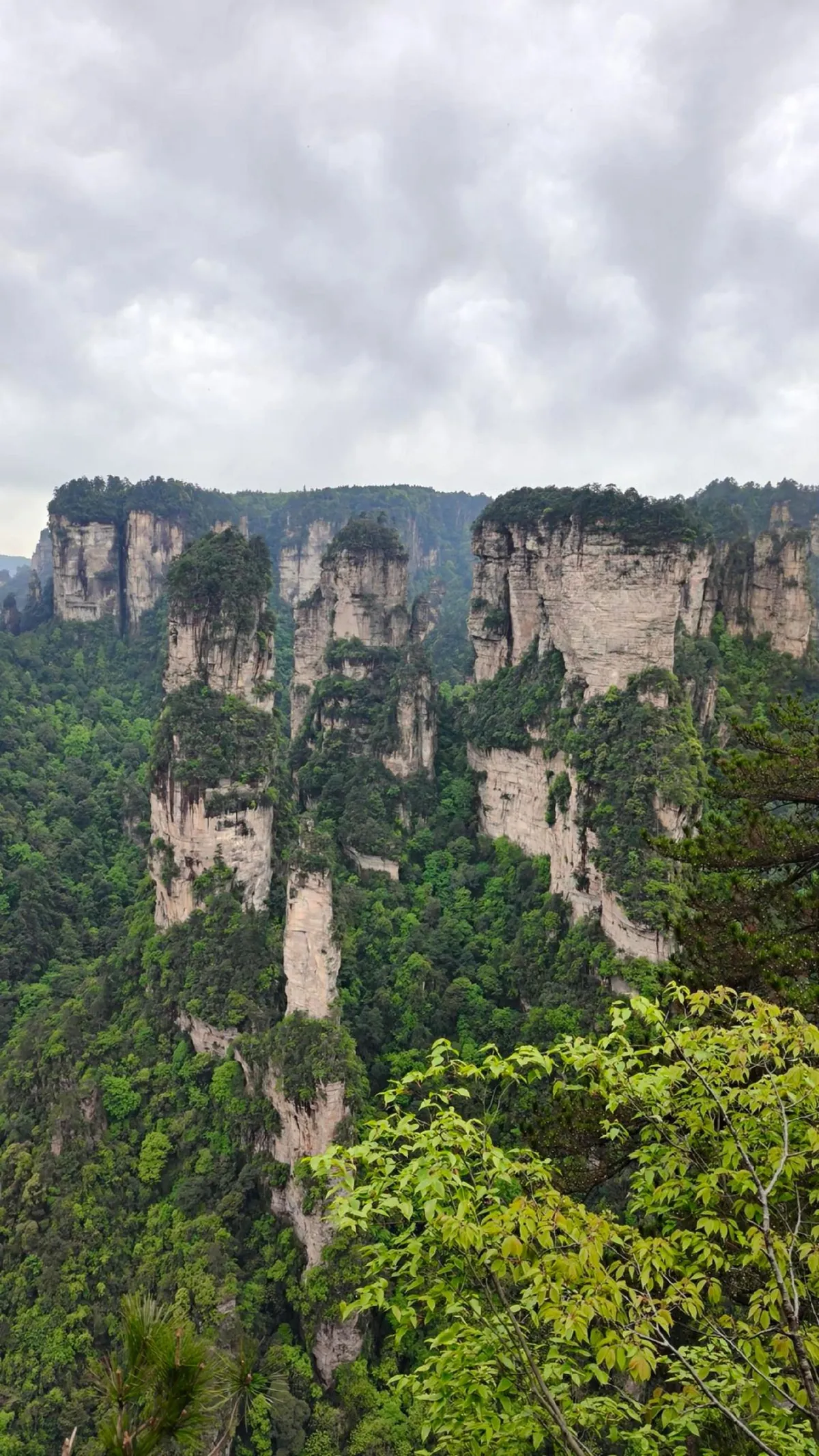
Where is Hunan, and how do you get in?
Two doors. International flights land at Changsha Huanghua; from there it is 2–3.5 hours by high-speed train to Zhangjiajie West, 1 h 45 at the fastest. Zhangjiajie’s Hehua airport serves Seoul all year plus a few seasonal routes, so most arrivals from abroad fly to Changsha, Guangzhou, Shanghai, Beijing, Chongqing or Hong Kong and finish by train or domestic flight.
- Two doors into Zhangjiajie itself: Hehua Airport (DYG) sits 5–6 km from the city centre, and Zhangjiajie West, the high-speed station, about 10 km out; from either it is 25–40 km to the park gates at Wulingyuan.
- From Changsha: use Changsha Station in the city centre, 1 h 45 – 2 h 10 on the Changde–Yiyang–Changsha line; Changsha South goes the long way round through Huaihua, 2 h 50 – 3 h 40. Every train ends at Zhangjiajie West; second class costs about ¥150–300.
- Direct from other cities: Chongqing East 15 trains a day, fastest 2 h 06; Guangzhou South 6 a day, 5.5–6 h; Hong Kong West Kowloon 1 a day, 6 h 42; Chengdu East 7 a day, 4–5.5 h. Shanghai and Beijing are a flight of 2–3 hours; by direct train they take 7 to 12 hours.
- On arrival: Wulingyuan is about 40 km from the airport (40–50 minutes, a taxi around ¥100) and about 25 km from Zhangjiajie West (30–40 minutes; ¥60–90 in a taxi, or ¥13–15 on the coach that leaves from the bus station next to the railway station).
- Visas: Hunan is inside China’s 240-hour visa-free transit scheme, Changsha Huanghua is one of its ports, and the permitted stay covers the whole province, Zhangjiajie included. More than 50 nationalities qualify, but the ports and the rules change, so check before you book.
The full list of direct trains and flights by city is on the getting-there page; which Changsha station to use, and how to reach it from the airport, is on the Changsha page.
The four places, and how many days each takes
Zhangjiajie is the floor at three days, four with the glass bridge. Fenghuang is a day and a night. Furong Town is half a day to a night. Dehang and the Aizhai Bridge sit between them and take half a day to a day in passing, with no separate trip needed. Changsha is a single day.
Zhangjiajie: the pillars, 3–4 days
Opened in 1982 as China’s first national forest park, Zhangjiajie National Forest Park is the core of the Wulingyuan World Heritage area: over 3,000 pillars of quartz sandstone, a great many of them taller than 200 m, and the model for the floating mountains of Avatar stands on the cliff tops of Yuanjiajie. The ticket is ¥165, valid for four consecutive days; one day covers the core, two see it properly. Tianmen Mountain, at the edge of the city, is a different day altogether: a single mountain with a cave through it and cliff-face walkways around the summit, four to six hours door to door, and since 13 October 2026 only Route C runs. The Grand Canyon glass bridge, 430 m long, is a separate scenic area on a separate ticket and takes half a day. How the days fit together is on the how-many-days page.
Fenghuang: the river town, 1–2 nights
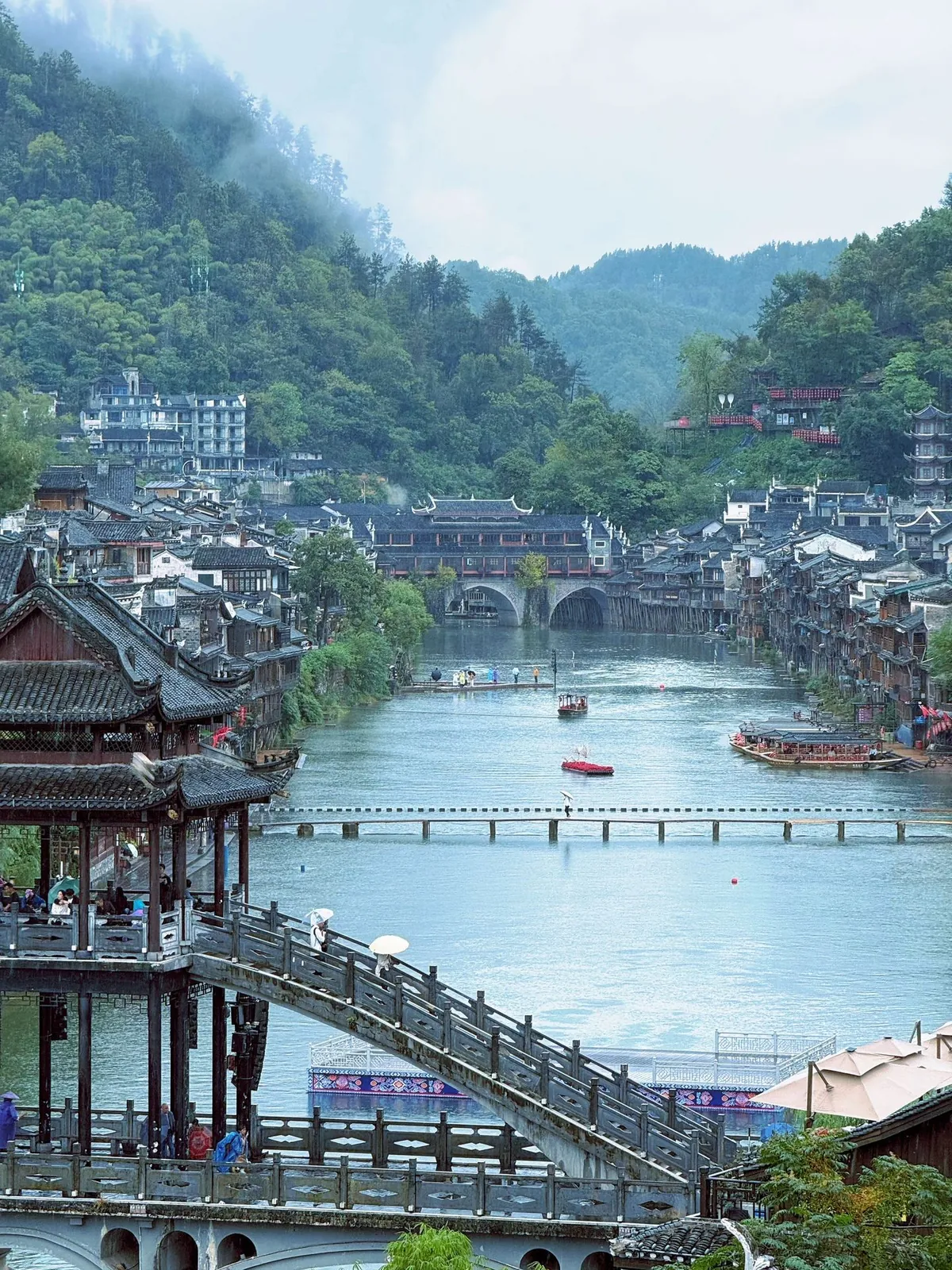
An old town on the Tuo River, in its present form since 1704: stilt houses lean out over the water, and after dark both banks are lit. Fenghuang itself has no gate ticket; you pay only for the individual sights and the boats, on combined tickets valid for two days. From Zhangjiajie West the high-speed train takes 51–66 minutes, second class ¥93, around 20 trains a day, and the old town is then about 10 km from the station, roughly 20 minutes by car. By road from Zhangjiajie it is about three hours. It is not next door, so it belongs at the end of the trip, with one or two nights. On to Changsha there are 13 trains a day, 1 h 52 – 2 h 37. Details on the Fenghuang page.
Furong Town: the town on a waterfall, half a day to a night
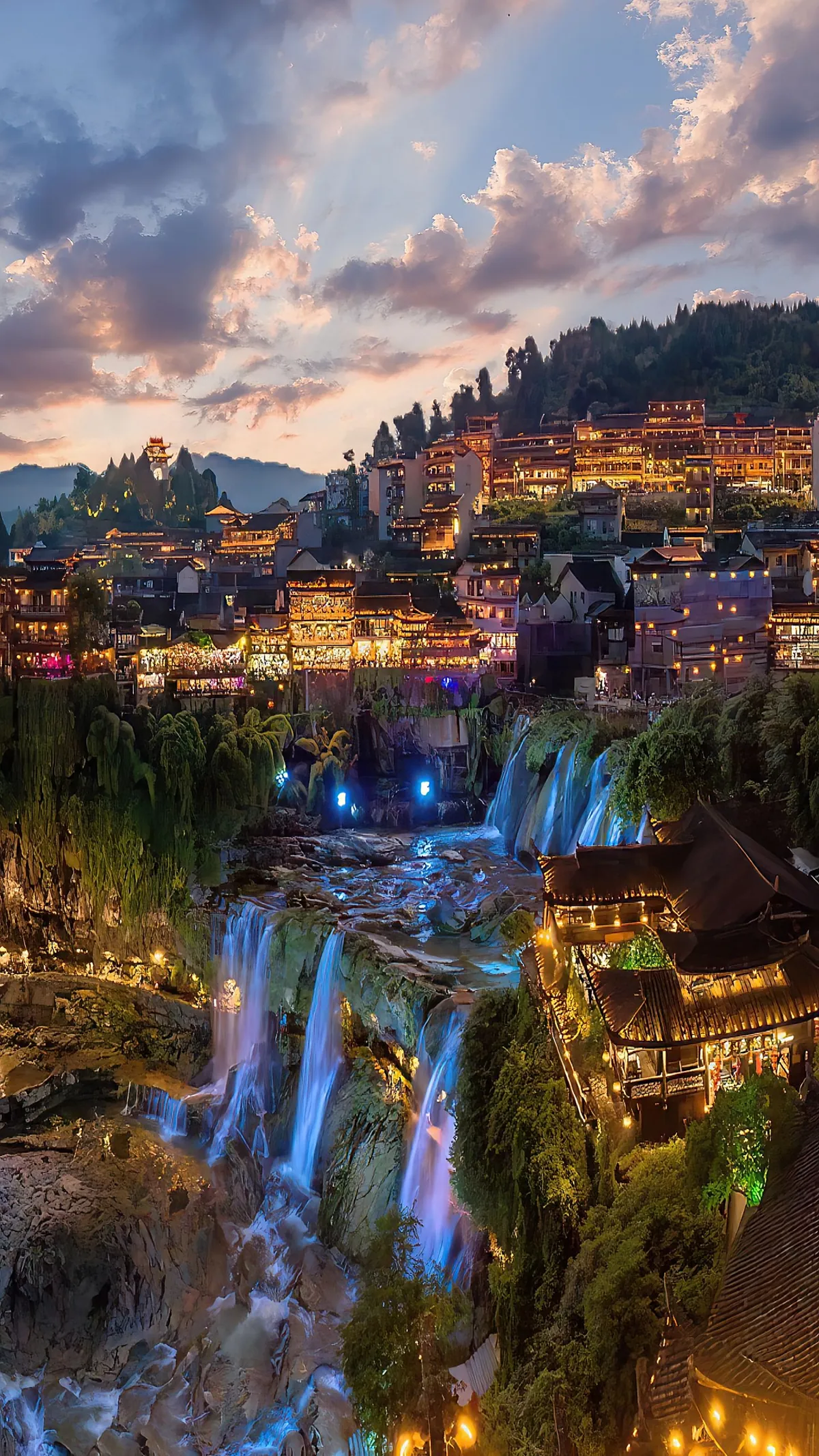
The old town stands on a two-tier waterfall that falls straight through it into the You River; its old name was Wangcun, and the present one came from the 1986 film Furong Town, filmed here, after which the village kept the title. From Zhangjiajie West it is 23–24 minutes by high-speed train, ¥40 second class, which makes it the easiest add-on to a Zhangjiajie trip. The ticket is ¥108, valid for unlimited entry over three days, and the walkway behind the waterfall is included. The town lights come on at 18:20 in October, around 19:30 in summer, and stay on until midnight, so it belongs to the evening. A day trip works: see the lights, then catch one of the trains back to Zhangjiajie West that leave between 21:30 and 22:00. On most days there are no morning trains back to Zhangjiajie; the first is at 11:58. Details on the Furong page.
Dehang and the Aizhai Bridge: half a day on the way
Between Zhangjiajie and Fenghuang lies the Xiangxi Tujia and Miao Autonomous Prefecture, administered from Jishou. A single high-speed line crosses it, calling at Zhangjiajie West, Furong Town, Jishou East and Fenghuang, and most travellers ride straight through. Two stops are worth it: the Aizhai Bridge, opened in 2012 with a main span of 1,176 m, where visitors walk the viewing galleries under the road deck rather than the road itself; and Dehang, the Miao village in the canyon beneath it, with the 216 m Liusha Waterfall, strongest after rain. Half a day to a day on the way covers both; neither needs a trip of its own. One ticket covers both: about ¥120 for a three-day pass plus ¥60 for shuttles and lifts, a promotional price valid to July 2027, checked November 2026. Details on the Xiangxi page.
Changsha: the gateway, one day
Changsha is the door into Zhangjiajie rather than a second destination, and one day is enough. The morning goes to the Hunan Museum and Lady Dai, the noblewoman buried at Mawangdui over 2,100 years ago: the museum is free, closed on Mondays and needs a booking made ahead — slots open five days before, with new dates released at 20:00 each evening, and a passport works. The afternoon is Orange Isle, a long island in the Xiang River about 5 km end to end, free but booked ahead since 30 March 2026, or Yuelu Mountain, free, with Yuelu Academy at its foot, founded in 976, about ¥40. The evening is Pozi Street or Taiping Street: rice noodles, stir-fried pork with chillies, spicy crayfish, sugar-oil rice cakes and stinky tofu. Next morning, the train from Changsha Station to Zhangjiajie West. Details on the Changsha page.
Two sample routes: five days and eight days
Five days is Changsha in and out with three Zhangjiajie days between. Eight adds a Changsha day and the two-day loop through Furong Town, Dehang and Aizhai to Fenghuang. Both follow the same rules: forest-park days back to back (the ticket runs four consecutive days); Tianmen Mountain first or last; Wulingyuan town for the park, the city before early trains.
Five days: Changsha in, Zhangjiajie, Changsha out
- Day 1 — land in Changsha and rest. A hotel near Changsha Station or Wuyi Square keeps the museum, the river and the next morning’s train close.
- Day 2 — an early train from Changsha Station to Zhangjiajie West, 1 h 45 – 2 h 10, then coach or car to Wulingyuan, 30–40 minutes. A morning arrival leaves the afternoon for Golden Whip Stream, a flat walk of two to three hours. Sleep in Wulingyuan town.
- Day 3 — the cliff tops: in at the East Gate, Bailong Elevator up to Yuanjiajie for the First Bridge and the Hallelujah pillar, then the shuttle across to Tianzi Mountain and the Tianzi cable car down. Sleep in Wulingyuan town.
- Day 4 — Tianmen Mountain on Route C, four to six hours; sleep in the city for the next morning’s train. In the evening, the Tianmen Fox Fairy show at 20:20 runs from mid-March to December (shows page).
- Day 5 — an early train back to Changsha, about two hours (getting-there page); half a day on Yuelu Mountain and the academy, or on Orange Isle; dinner on Pozi Street; fly out that night or the next morning.
What this leaves out is the glass bridge. The how-many-days page adds the bridge only on a fourth Zhangjiajie day; to have it here, give up the Changsha half-day on day five, spend that morning at the bridge, 20–45 minutes from Wulingyuan town, and go to the station after lunch. It is one or the other.
Eight days: add Furong Town, Dehang–Aizhai and Fenghuang
- Day 1 — land in Changsha and rest.
- Day 2 — a Changsha day: the museum in the morning (booked ahead; slots open five days before), Orange Isle or Yuelu Mountain in the afternoon, Pozi Street at night.
- Day 3 — an early train to Zhangjiajie West and on to Wulingyuan; the afternoon on Golden Whip Stream or the Ten-Mile Gallery tram. Sleep in Wulingyuan town.
- Day 4 — the cliff tops, as on day three of the five-day plan. Sleep in Wulingyuan town.
- Day 5 — Tianmen Mountain on Route C, four to six hours; sleep in the city.
- Day 6 — train from Zhangjiajie West to Furong Town, 23–24 minutes; the afternoon on the walkway behind the waterfall, the evening for the lights. Sleep in Furong Town: inns over the falls (the water is loud all night), stilt-house guesthouses inside the town, or hotels on flat ground outside it.
- Day 7 — Furong Town to Dehang and the Aizhai Bridge, about 1.5 hours by car, or 20–28 minutes by train to Jishou East and a car from there; half a day in the canyon and on the bridge; then about an hour by car to Fenghuang. Sleep in Fenghuang, for the lights.
- Day 8 — Fenghuang to Changsha by high-speed train, 1 h 52 – 2 h 37, 13 a day; fly out of Changsha.
The two-day loop comes from the Xiangxi page and also runs in reverse; here it simply follows the three Zhangjiajie days. It runs south and leaves from Fenghuang rather than returning to Zhangjiajie because Furong Town has, on most days, no morning train back to Zhangjiajie West. If you would rather not sleep in Furong Town, the how-many-days page has a six-day version that takes in both towns in the order Zhangjiajie West → Furong Town → Fenghuang, or the reverse.
When to come
Zhangjiajie never closes; the season decides what you see: cloud seas after spring and summer rain, autumn’s clear air, winter’s occasional snow and rime. Easiest: late April–May and late September to mid-October, minus 1–7 October. Cloud seas: April–June and September, the clear morning after rain. Quiet and cheaper: November, early December, January outside the New Year week.
- Two weeks to avoid. National Day, 1–7 October, is the year’s busiest week: in 2026 the gates opened at 06:30 and the cable cars and lift were rationed. The other is the week around Chinese New Year, 6 February 2027.
- Rain is good news. The cloud sea is what rises from the valleys after it. If rain is forecast, change the order, not the dates: walk the valleys (Golden Whip Stream, the Ten-Mile Gallery, Huanglong Cave) on the wet day and go up to the cliff tops on the clear morning after.
- Cold on top. The viewing platforms feel five to eight degrees cooler than the city in rain and in winter; bring a jacket in any month.
- The towns and shows keep their own calendar. Furong Town’s lights come on at 18:20 in October and around 19:30 in summer; the Tianmen Fox Fairy show pauses in January and February and resumes in mid-March; the Dehang canyon sits in fog for close to half the year, its steps ice over in cold snaps and the waterfall thins in winter, and off-season visitors report a quiet village with no performances.
The month-by-month table, with temperatures and rainy days, is on the weather page. Its figures are for Zhangjiajie city; this page does not stretch them to Changsha or the old towns.
Where to sleep
Two bases, about 40 km and 40–50 minutes apart. For park days, Wulingyuan town, just outside the forest park’s East Gate. For Tianmen Mountain and early-train nights, Zhangjiajie city, which has the airport, the railway station and the Tianmen cableway station. Over three or four days: two or three nights in Wulingyuan, one in the city.
- Wulingyuan town. The East Gate ticket office is five to ten minutes away by car; check the distance on a map, not the hotel’s name. Two things come up again and again from people who have stayed: be within walking distance of the gate, since early-morning taxis are scarce, and expect rates noticeably above the city’s, higher still on holidays.
- The city. A free shuttle links the cableway’s city station to the mountain gate in about 20 minutes. For the first cableway of the day, judge a hotel by one figure: how many minutes’ walk to the Tianmen cableway city station. “Central” covers a lot of ground here; a hotel so described can be half an hour away by car.
- The old towns. A night each, in the town itself, for the lights. Fenghuang and Furong Town each get a night of their own; neither works as a base for Zhangjiajie.
- Changsha. Stay near Changsha Station or Wuyi Square: the museum, the river and the morning train are then all within easy reach.
How the nights split on two-, three-, four- and five-to-six-day trips is on the where-to-stay page, and the full list of things to do in and around the park is on the things-to-do page.
Fares, ticket prices, opening hours and train times on this page are carried over from the pages it links to, each checked on the date shown there; all of them change by season. Treat them as a guide, not a quote.
Quick answers
Is Zhangjiajie in Hunan?
Yes. Zhangjiajie, Fenghuang and Furong Town all lie in western Hunan: Xiangxi is its hill country, and Zhangjiajie city sits just beyond Xiangxi’s northern border. “Zhangjiajie” usually means the national forest park inside the Wulingyuan World Heritage area; Tianmen Mountain, at the city’s edge, is a separate day.
How many days do I need in Changsha?
One. The Hunan Museum in the morning, Orange Isle or Yuelu Mountain in the afternoon, Pozi Street in the evening, and the early train to Zhangjiajie West next morning. Only travellers with a spare day add anything else.
Is Hunan food spicy?
Yes — this is the home of stinky tofu and the rest of Hunan’s fiery cooking. The dishes people order are stir-fried pork with chillies, spicy crayfish and stinky tofu with chilli sauce — and with the tofu, the taste is milder than the smell.
Can I do Fenghuang as a day trip from Zhangjiajie?
The train takes 51–66 minutes, but the station is another 20 minutes from the old town and the lights are the point, so most give it one or two nights at the end. A day trip suits Furong Town better: 23–24 minutes each way, trains back between 21:30 and 22:00.
Do I need a visa for Hunan?
Hunan is inside China’s 240-hour visa-free transit scheme; Changsha Huanghua is one of its ports and the permitted stay covers the whole province. The conditions and the list of ports change, so check before you travel.
Which airport should I fly into?
Changsha Huanghua: that is where the international flights come in. Zhangjiajie Hehua flies to Seoul all year and otherwise only seasonally. From Changsha the high-speed train reaches Zhangjiajie West in 1 h 45 at the fastest.